
A group of labeled borosilicate glass flasks and Erlenmeyer bottles containing diverse microbial bioestimulant cultures for crops, each with slightly different amber, pale green, and milky hues, resting on a pristine white laboratory bench. Behind them, a compact laminar flow cabinet and a modern incubator with a digital display form a softly blurred background. Cool, uniform laboratory LED lighting reflects subtly off the glass surfaces, emphasizing clarity and sterility. The mood is precise and methodical, with a minimalist, professional aesthetic. Shot at eye level with a moderate depth of field, the central row of flasks occupies the lower third of the frame, focusing attention on agrobiotechnological innovation that enhances water-efficient agriculture in arid environments.

Optimización del agua en agricultura

Conoce el propósito científico y el impacto territorial de este proyecto que impulsa una agricultura resiliente en contextos áridos.

Objetivos

El Proyecto Anillos busca optimizar el uso del agua en agricultura de zonas áridas mediante aeroponía vertical, bioestimulantes microbianos y tratamiento de aguas con sistema DHS, generando soluciones agrobiotecnológicas sostenibles transferibles a productores, instituciones y tomadores de decisión.
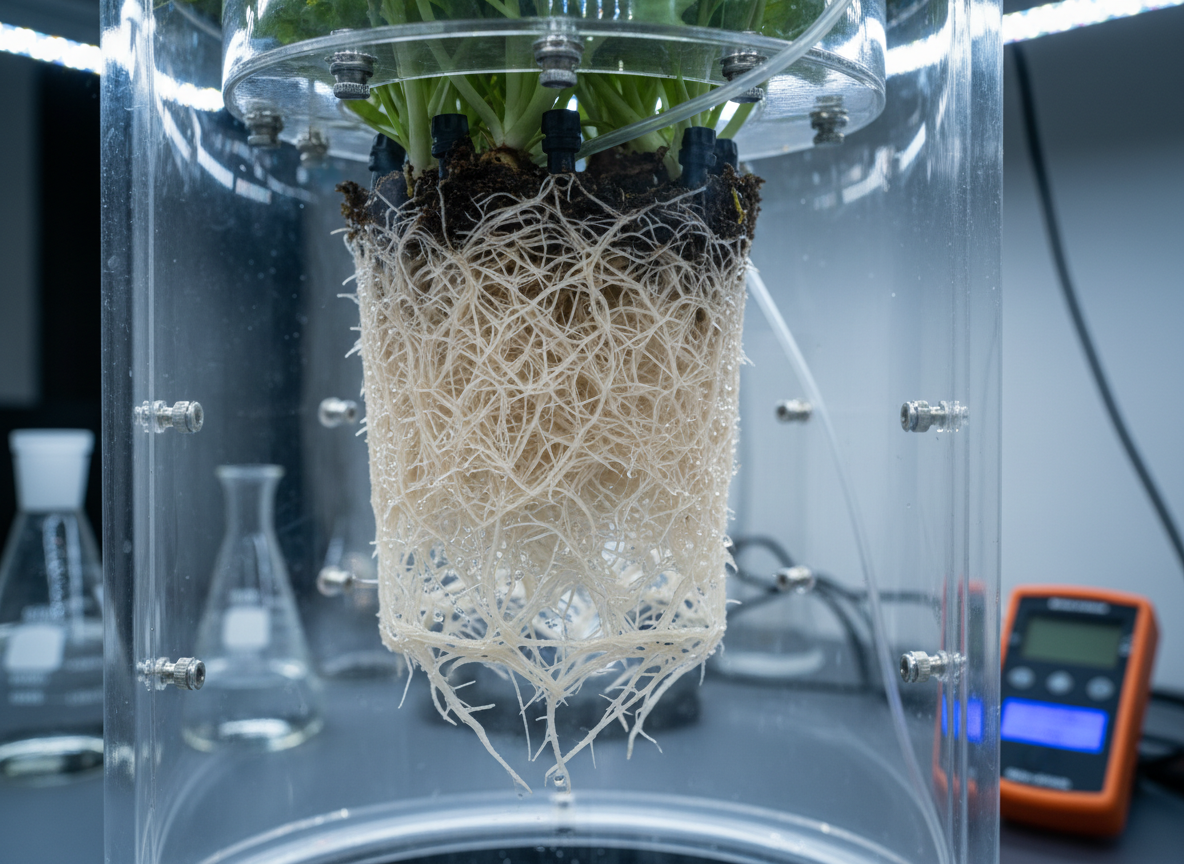
A close-up photographic view of plant roots suspended in midair inside a vertical aeroponic chamber, coated with a fine network of white root hairs and glistening droplets of nutrient solution. The transparent polycarbonate wall reveals calibrated spray nozzles and thin irrigation lines around the roots. The background shows an out-of-focus laboratory bench with labeled glass flasks and a compact data logger. Cool, even LED lighting from above and the sides creates gentle highlights on the moisture and a clinical, controlled atmosphere. Shot with a macro lens and very shallow depth of field, the composition isolates the roots in the center, evoking precision, efficiency, and the scientific optimization of agricultural water use.